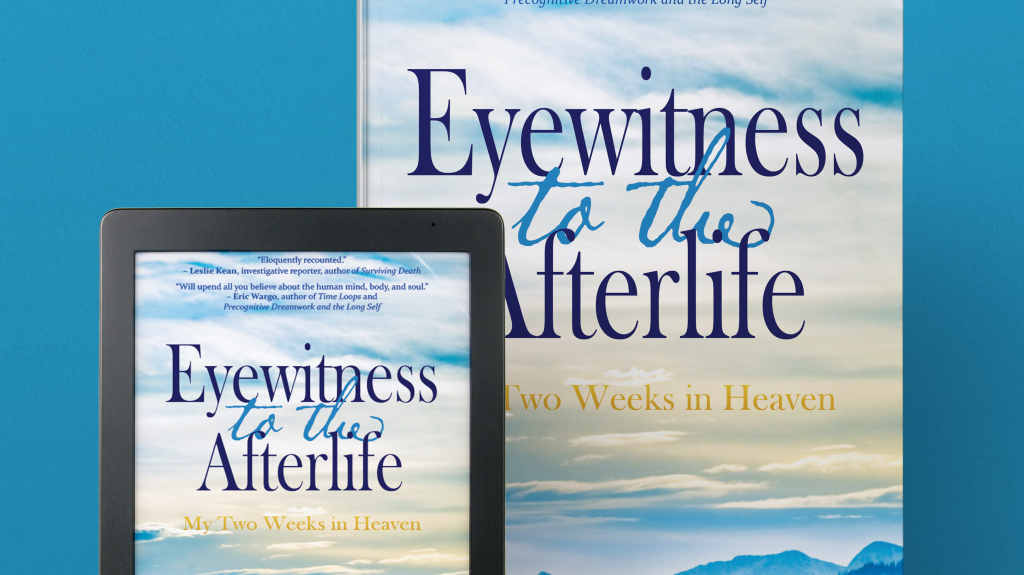
A few months ago, I founded a new organization called the Mind & Meaning Institute, to help further scientific and philosophical research into big questions about consciousness, synchronicity, destiny, and the meaning of life. Last week, we released our first publication, the book Eyewitness to the Afterlife: My Two Weeks in Heaven by Elizabeth G. Krohn, with a foreword by Rice University professor Jeffrey J. Kripal.

This book is Elizabeth Krohn’s BICS award-winning essay that details the near-death experience (NDE) she had 35 years ago when she was struck by lightning. She had always been skeptical of anything beyond the material world, but that quickly changed when she found herself looking down at her lifeless body, her consciousness intact. Soon, she was sitting in a beautiful, vibrant garden, talking to someone she strongly suspected was God.
Elizabeth was given information about her life, the universe, even the future. When she returned to her body, not only did that information prove accurate, but her life became an avalanche of increasingly unsettling experiences. She spent the next 35 years navigating a new reality filled with alarmingly detailed precognitive nightmares as well as other highly strange events, like a telephone call from her deceased grandfather and a necklace that appeared to foretell death.
I’ve read a lot of accounts from near-death experiencers, but Elizabeth’s is truly in a class of its own. Eyewitness to the Afterlife is a riveting firsthand account of just how little we know about the reality we inhabit — particularly the nature of time — and how much it stands to transform our lives when we come into deeper contact with it. I know Elizabeth’s inspiring, thought-provoking testimony is going to touch a lot of people, and I encourage you to check it out on Amazon, or ask for it wherever you buy books!
 Sharon Hewitt Rawlette, PhD
2 responses to “Eyewitness to the Afterlife”
I’m reluctant to comment. I’m a nonbeliever. My question is what makes anyone believe it had anything to do with anything outside of her own mind? This was the reaction of her brain to something that was trying to kill her. The brain took a big hit and survived. Take care. GROG
That’s a very important question! In general, the strongest evidence for the reality of what happens during near-death experiences is the perceptions people have of things that they couldn’t normally perceive, like things happening in other locations, or things that for whatever reason their body wasn’t in a position to perceive. There are some really stunning cases of this, which I describe in my book Beyond Death and which you’ll find even more detail about in the book The Self Does Not Die, by Smit, Rivas, and Dirven. In Elizabeth’s case in particular, while « on the other side, » she was told things that were going to happen in the future, including who would win the upcoming presidential election and who would win the Super Bowl. Those things came true, and that in my opinion is the strongest evidence that she was not simply having a very vivid dream. Of course, she herself says that the experience was NOTHING like a dream, that it was utterly real. And I think that’s an important data point as well, as Jens Amberts argues strongly in his book Why an Afterlife Obviously Exists. A final important piece of evidence is the enormous changes the experience created in Elizabeth’s personality, psychology, and physiology. As she says in her book, when she came back, she was no longer the person she’d been before the experience, and the stunningly detailed precognitive dreams she began to have afterward testify to a very different relationship she began to have to time and to knowledge in general. If you want to know why the experience was convincingly real to Elizabeth and to those of us who have studied it, I highly recommend reading her book. I think you’ll be surprised at the power of the details she recounts. Thanks for commenting!